Łukasz Sagun
2026-03-25
•
6
min

In an organization with multiple locations, hundreds of devices, and dozens of people responsible for using them, the question isn't "how much in assets do we have?". The key questions are: "where are they, who is using them, what is their condition, and do we actually need to buy another one?". Fixed asset managementanswers these questions, provided it is not limited to a simple accounting ledger.
A well-designed process connects financial records with the actual lifecycle of an asset. It provides administration, finance, operations, and inventory teams with a single view of the situation. This translates into fewer errors, faster processes, and purchasing decisions based on data rather than assumptions.
A fixed asset enters an organization the moment it is purchased or received. At that point, it is assigned an inventory number, value, category, location, and a responsible person. However, registration alone is not enough. Over the following years, the item may be moved, transferred to another user, serviced, temporarily taken out of service, or disposed of.
If these events are documented in emails, spreadsheets, and local logs, the data quickly loses its reliability. The finance team may have the correct book value, but administration does not know where the device is physically located. Meanwhile, the operations department might order equipment that is already available at another branch.
Full asset management should cover the entire lifecycle: planning and purchasing, receipt, labeling, assignment to a user, transfers, maintenance, inventory, accounting, and disposal. It is this combination of stages that allows for control over both accounting compliance and resource utilization.
A lack of up-to-date asset data rarely leads to one spectacular failure. It usually generates a series of minor losses: unnecessary purchases, time spent searching for items, delayed handovers, difficulties during inventory, and disputes over equipment responsibility. In a decentralized organization, the scale of these problems grows very quickly.
A typical scenario is simple. An employee submits a request for a laptop, medical device, tool, or workstation equipment. The approver does not see that an identical item is sitting unused in another location or is waiting to be reissued after service. The purchase is made, and the surplus asset remains uncontrolled.
The point is not to block justified purchases. The goal is to enable quick decisions based on reliable information: what the organization owns, the technical condition of the assets, where available resources are located, and how much it costs to maintain them. Such visibility allows for better utilization of existing assets before the company commits further funds.
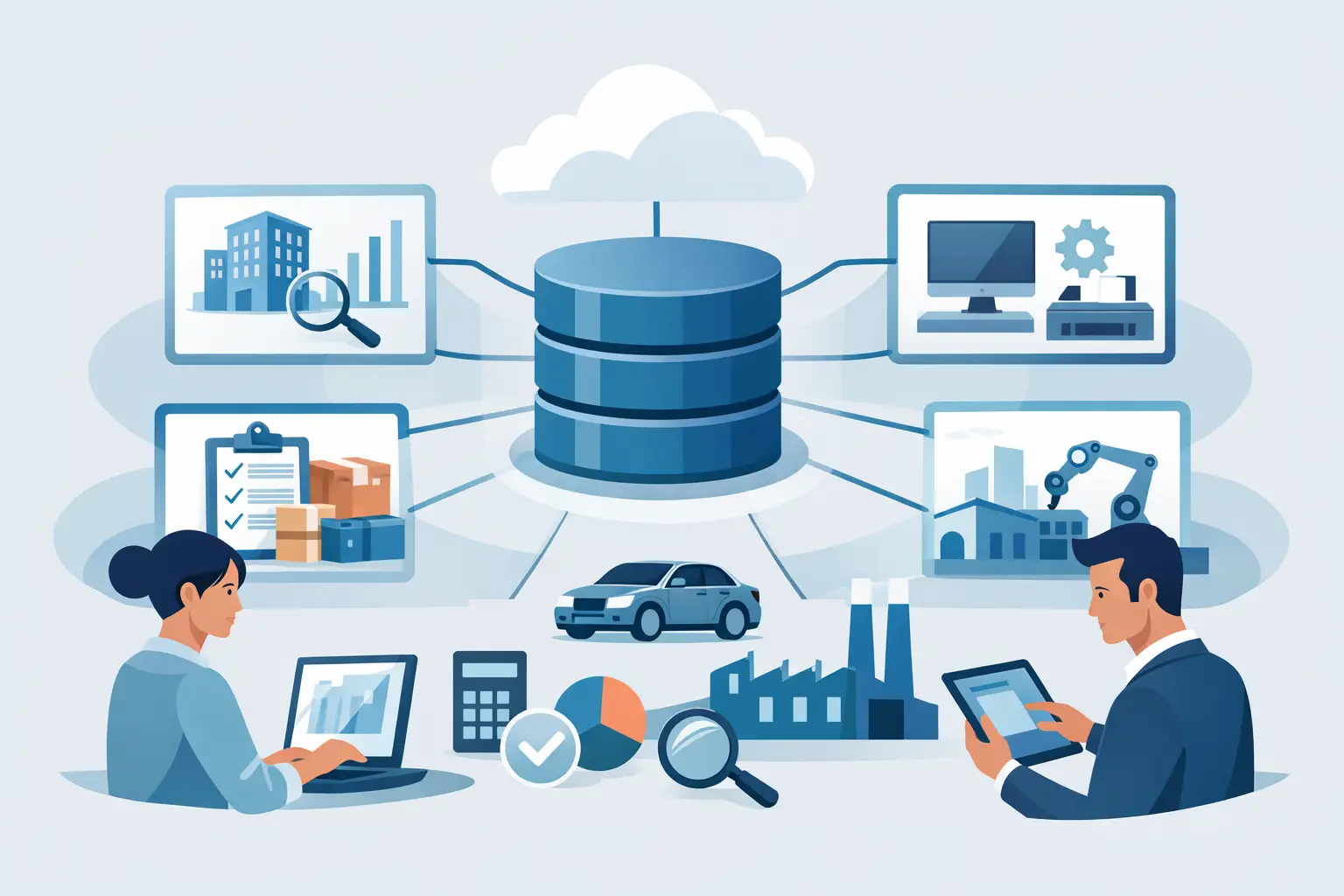
A central data repository organizes accountability and eliminates the problem of multiple versions of the same register. Each item should have a record containing not only the information required for accounting but also data useful for operations: serial number, location, user, purchase documents, transfer history, service dates, warranty, and availability status.
It is worth separating information that describes different perspectives of the same resource. Finance needs initial value, depreciation rates, and data for settlements. Administration needs location and user assignment. The technical department requires service history and inspection dates. The system should combine this data on a single record while providing roles and permissions appropriate for each team.
This is particularly important in entities with high procedural requirements, including healthcare. In such environments, incomplete information about a device can mean not only a cost issue but also an operational risk and difficulty in demonstrating procedural compliance.
Centralization alone does not guarantee data quality. A register will only be reliable if updates occur at the moment an event takes place. Moving equipment should be recorded at the time of transfer, not during the annual inventory. Changing a user cannot depend on the memory of a few people. Disposal should trigger a controlled approval path and leave an audit trail.
That is why it is worth automating repetitive tasks: maintenance reminders, responsibility confirmation tasks, missing data notifications, and approval workflows. Automation does not replace accountability, but it significantly reduces the number of situations where information gets lost between departments.
Inventory is a moment of truth for any asset register. If it requires printing sheets, manually retyping numbers, and weeks of reconciling discrepancies, the organization pays for it with the time of many employees. Worse, the results are often outdated just days after the count is finished.
A more effective model is based on clear asset labeling and mobile confirmation of their presence. Barcode or QR code labels speed up identification and reduce errors resulting from manual reading. The employee conducting the count sees tasks for their assigned location, scans the label, and immediately saves the result to the central database.
Discrepancies should not reach the final report without explanation. The system can route them to the appropriate people: the user, the location manager, administration, or the finance department. This allows discrepancies to be resolved on an ongoing basis, rather than only after the entire inventory is closed.
For distributed assets, it is worth considering continuous or cyclical inventory for selected asset groups. Not every organization needs the same frequency of checks. High-value, mobile, or operationally critical equipment usually requires more frequent verification than stable equipment assigned to a single room.
Implementation should not start with moving all data into a new tool. First, you need to determine what decisions the organization wants to make based on asset information. Is the priority to shorten inventory time, limit purchases, control employee equipment, ensure compliance, or manage service? The answer determines the scope of data and the flow of processes.
Next, you should organize the location structure, asset categories, identifier assignment rules, and user roles. This is the stage where the foundation for later automation is built. Overly general categories and ambiguous statuses will quickly recreate chaos, even in a good system.
The next step is verifying the starting data. It is not always worth cleaning up the full history of multi-year records right away. It is often more reasonable to start with assets currently in use and supplement archival data according to an established priority. The scope depends on the risk, the scale of assets, and the organization's control requirements.
Finally, there is the task of preparing people to work in the new model. Employees do not need long theories about the system. They need clear answers on what to do when receiving equipment, changing locations, transferring a device, or detecting a discrepancy. The eMajątek 4.0 methodology used by EXINO BUSINESS SYSTEMS combines technology with this operational approach to implementation so that the process works beyond just a system presentation.
The number of registered items is not a measure of process maturity. Indicators related to quality and efficiency say much more: the percentage of assets confirmed on time, the time taken to complete a transfer, the number of unexplained discrepancies, the value of recovered resources, and the number of purchases preceded by checking availability within the organization.
It is also worth measuring data completeness. If a fixed asset card does not contain the current location, user, or status, the team should see this gap immediately. Exception reporting is, in practice, more useful than a long report of all items, as it directs attention to areas requiring action.
Mature fixed asset management is not just about "having a register." It is about ensuring that for every decision regarding a purchase, transfer, service, or inventory, the right information is available immediately. It is a process-driven order that reclaims team time, reduces costs, and gives the organization control over the assets it uses every day.

















.webp)