Łukasz Sagun
2026-03-25
•
8
min

Lacking up-to-date information on where equipment is located, who is using it, and what its condition is quickly stops being just an administrative issue. It becomes an operational cost: it leads to unnecessary purchases, prolongs inventory processes, complicates accounting, and increases the risk of non-compliance. This guide to asset management shows how to build a process that gives an organization real control over its fixed assets and equipment—even when that property is scattered across different branches, departments, and users.
Asset management is an organized collection of data regarding an organization's components and the events that affect them. It involves more than just entering an item into a register after purchase. It should document the entire lifecycle of an asset: acquisition, labeling, assignment to a location or person, transfers, maintenance, upgrades, inventory, disposal, or sale.
In practice, it is necessary to distinguish between two perspectives. Financial accounting answers questions about initial value, depreciation, rates, and financial documents. Operational management answers questions that arise in daily work: where is the device, is it available, who is responsible for it, when does it need a check-up, and does a similar, unused resource already exist?
Both perspectives should be consistent, but they are not the same process. An organization that limits itself solely to financial data may keep its books correctly while having no control over the actual use of its assets. Conversely, local equipment lists without links to documentation and accountability rules quickly lose their credibility.
Effective management does not start with choosing technology. It starts with determining what decisions need to be made based on the data. If the goal is to reduce purchasing, the register must show the availability and condition of items. If compliance is the priority, a history of changes, documents, and access control are necessary. If the organization wants to shorten inventory time, it needs clear labeling and a mobile way to confirm the presence of resources.
Only then is it worth defining the scope of the management system. In large organizations, this usually includes fixed assets, low-value equipment, IT hardware, technical apparatus, furniture, medical devices, tools, and infrastructure components. The scope depends on the risk, value, mobility, and replacement cost of a given item. Not every component requires the same level of detail, but every one should be subject to a clear rule.
An asset card should contain enough data to identify, account for, and service the item. The minimum set includes the name, unique identification number, category, serial number, acquisition date, value, funding source, location, person or department responsible, and usage status.
For equipment requiring technical maintenance, it is worth adding deadlines for inspections, warranties, service contracts, certificates, and repair history. For organizations operating in multiple locations, a precise structure of usage sites is also important: not just the branch, but also the building, floor, room, and potentially the specific workstation.
A record that is too sparse provides no basis for management. One that is too extensive burdens users and lowers data quality. Therefore, it is best to adopt this rule: a field belongs in the register only if it serves a decision, a legal requirement, or a specific operational process.
The system number must be linked to the physical item. Most commonly, barcode or QR code labels are used, and in cases of large scale, high mobility, or the need for rapid scanning, RFID is also used. The choice of technology should be driven by working conditions, not just the popularity of the solution.
QR codes work well for phone scanning and moderate-cost implementations. RFID speeds up the scanning of large numbers of items but requires an analysis of the environment, the type of labels, and the handling process. In a hospital, warehouse, office, or manufacturing plant, identification conditions can be completely different.
The durability of the label is key, as is the principle that the identifier is assigned upon receipt of the item, before it reaches the user. Labeling assets only before inventory creates extra work and fails to reconstruct the history of previous movements.
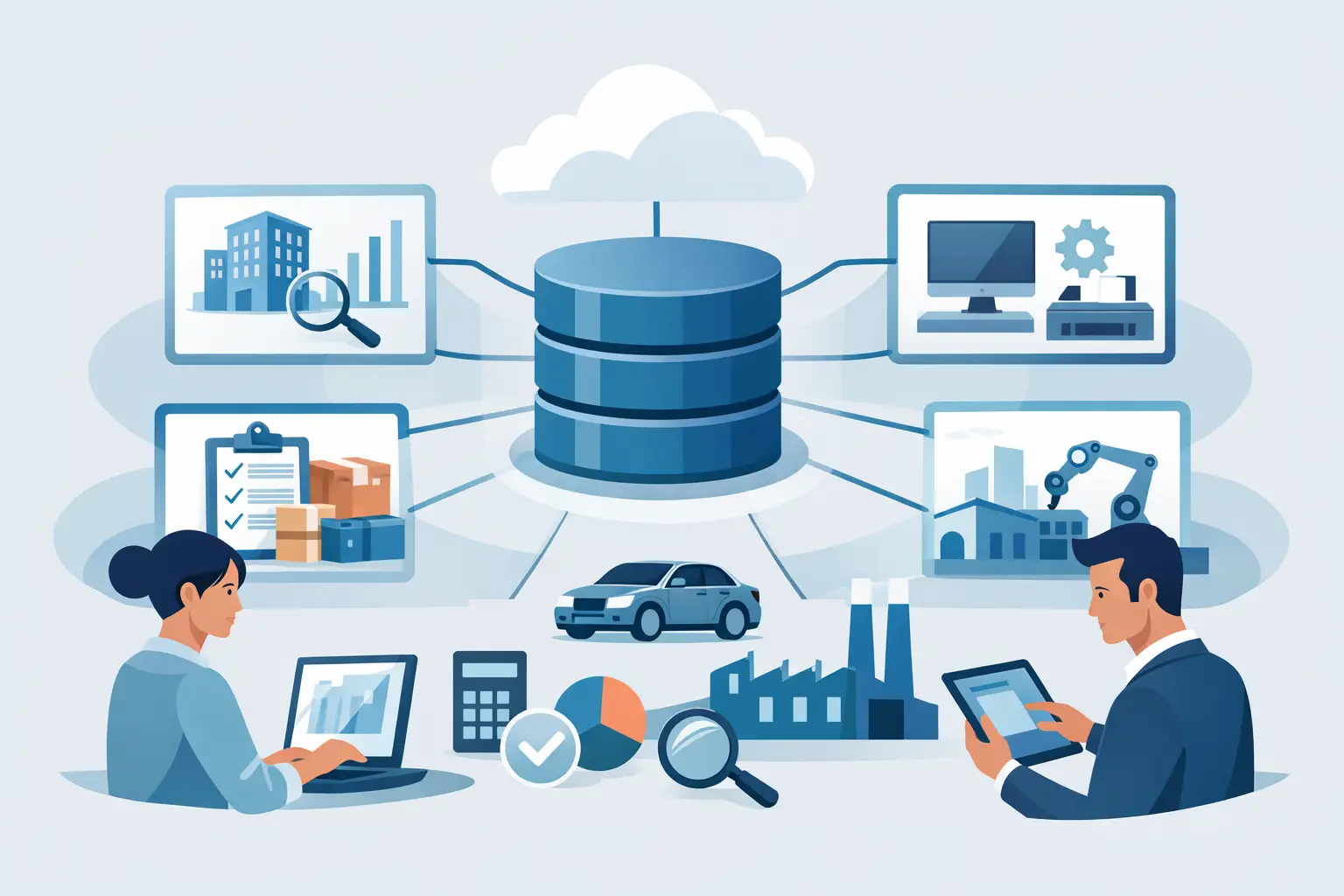
A central database is only valuable when it reflects real-world events. Otherwise, it becomes just another spreadsheet that requires manual reconciliation. A well-designed process defines who updates data and when, and what confirmation remains after an operation is completed.
The most critical moments are those involving the transfer of responsibility. Moving a laptop to a different department, issuing a device to an employee, transferring equipment between facilities, or sending hardware for service should all have a process owner and a digital trail. This isn't about increasing bureaucracy; it's about eliminating situations where the finance department has one set of information, administration has another, and the user has a third.
In practice, it is worth standardizing at least the following: intake, location changes, user changes, temporary issuance, service, inventory, and disposal. For each of these events, you should define the required data, the approving person, and the document or digital confirmation needed.
Inventory should not be the only time an organization learns what it owns. Its role is to confirm that recorded data matches reality, to explain discrepancies, and to improve the process for the future.
The most common mistake is treating a physical stocktake as a one-off project carried out under a deadline. In such cases, teams print lists, move between locations, manually mark results, and spend a long time explaining discrepancies. The cost includes not only the committee's time but also user involvement, work interruptions, and the risk of errors during data entry.
Digital records enable inventory management using a mobile device, allowing you to record readings directly at the asset and identify differences in real-time. However, technology cannot replace preparation. Before starting the stocktake, you must freeze or control location changes, establish responsibilities, update the organizational structure, and prepare a method for handling unlabeled or damaged items.
An inventory discrepancy does not always mean a loss. It often points to an undocumented transfer, a room name change, an incorrect user assignment, or a failure to update records after service. It is worth analyzing the causes systematically. If the same types of discrepancies repeat across several locations, the problem is the process, not an individual entry.
One of the most measurable effects of good record-keeping is the ability to utilize resources the organization already owns. Without a central view, administration often responds to a purchase request by buying new equipment because they lack quick information about available hardware in another department, warehouse, or branch.
An asset register should therefore show operational statuses: in use, available, in service, retired, designated for disposal, or awaiting transfer. It is also worth reporting items unused for a certain period, upcoming warranty expirations, and devices with high repair costs. This allows for decisions based on facts rather than intuition.
Not every organization needs full integration with purchasing, accounting, and service systems immediately. With a high volume of events or multiple locations, integration significantly reduces manual work. On a smaller scale, the greatest benefit may come from first organizing basic data and establishing update discipline. Implementation should be carried out in stages, but designed from the start to provide a single, reliable picture of assets.
Even the best system will not keep data up to date without clearly defined roles. The finance department is usually responsible for the accuracy of value records, administration for location and user data, and department heads for confirming responsibility for entrusted assets. IT or the technical department may be responsible for service, configuration, and the lifecycle of specific equipment groups.
It is important not to shift all responsibility onto one person managing the register. Information about a transfer is created where the transfer occurs. The system should make it easy for the appropriate user to register it, and permission and approval mechanisms should ensure control over changes.
Data quality is worth measuring. Practical indicators include the percentage of items with a confirmed location, the number of items without an assigned custodian, the number of open inventory discrepancies, the time taken to complete a transfer, and the share of unused assets. Such metrics show whether the records actually support management or merely fulfill a formal obligation.
The starting point should be an audit of the current state: data sources, asset categories, labeling, locations, existing procedures, and recurring issues. Next, you should define the target data model and the processes with the greatest impact on costs and risk. These are typically acquisitions, transfers, user accountability, and inventory management.
In organizations with distributed assets, it is particularly important to implement a platform that connects a central repository, mobile support, and automated reminders. The eMajątek 4.0 methodology used by EXINO helps translate these requirements into a practical working model, rather than limiting the project to simply moving data from spreadsheets into a new system.
Well-maintained asset records are not just a registry for the sake of a registry. They are the foundation for decisions regarding purchases, resource utilization, accountability, and costs. The greatest value is realized when every change in the physical state of an asset is automatically reflected in the data that the organization relies on for its daily operations.
















.webp)