Łukasz Sagun
2026-03-25
•
7
min

In an organization with thousands of fixed assets and equipment items, the problem rarely starts with a lack of data. More often, the data exists but is scattered across spreadsheets, financial systems, paper documents, and the minds of employees. Automating corporate asset management changes this model: it replaces manual information reconciliation with a single, up-to-date view of assets, their locations, users, and status.
This is not just an IT project. A well-designed automation process reduces the costs of unnecessary purchases, shortens inventory cycles, minimizes recording errors, and makes it easier to demonstrate compliance with procedures. There is one condition: the technology must reflect the actual way the organization operates, rather than simply digitizing existing chaos.
Manual asset management usually works fine until the scale increases. Another location, a new department, equipment assigned for remote work, or a device replacement are enough for discrepancies to start mounting. The administration department asks about equipment availability, finance compares records with documents, and those conducting physical inventory try to determine what is actually in a given room.
The most expensive part is not a single typo in an asset name. It is the lack of a repeatable information flow. When handing over a laptop, changing a usage location, or retiring a device is not recorded immediately, the records quickly stop reflecting the actual state. Consequently, the organization buys resources it already owns, prolongs inventory processes, and makes decisions based on incomplete data.
In sectors with high procedural requirements, including healthcare, the stakes are even higher. Assets are often linked to workplace safety, service continuity, audits, and the obligation to demonstrate the usage history of specific devices. Here, improvising with data management is not a convenient shortcut, but an operational risk.
Automation is not just about labeling items with a barcode or RFID tag. Identification is the starting point, as it allows you to quickly recognize a specific asset in the field. Full business value is only achieved by combining identification with a central registry, workflow rules, and data accountability.
In practice, the system should record more than just the inventory number and asset value. You also need information about the category, location, responsible person, movement history, documents, technical condition, and deadlines requiring attention. Thanks to this, answering the question "where is this equipment?" does not require several phone calls and searching through attachments.
Automation also covers events that were previously handled manually: receiving a fixed asset, issuing it to a user, moving it between locations, periodic verification, servicing, disposal, or status changes. A defined workflow guides the user through the correct steps, requires the necessary information, and creates an audit trail. This reduces the process's dependence on the memory of specific individuals.
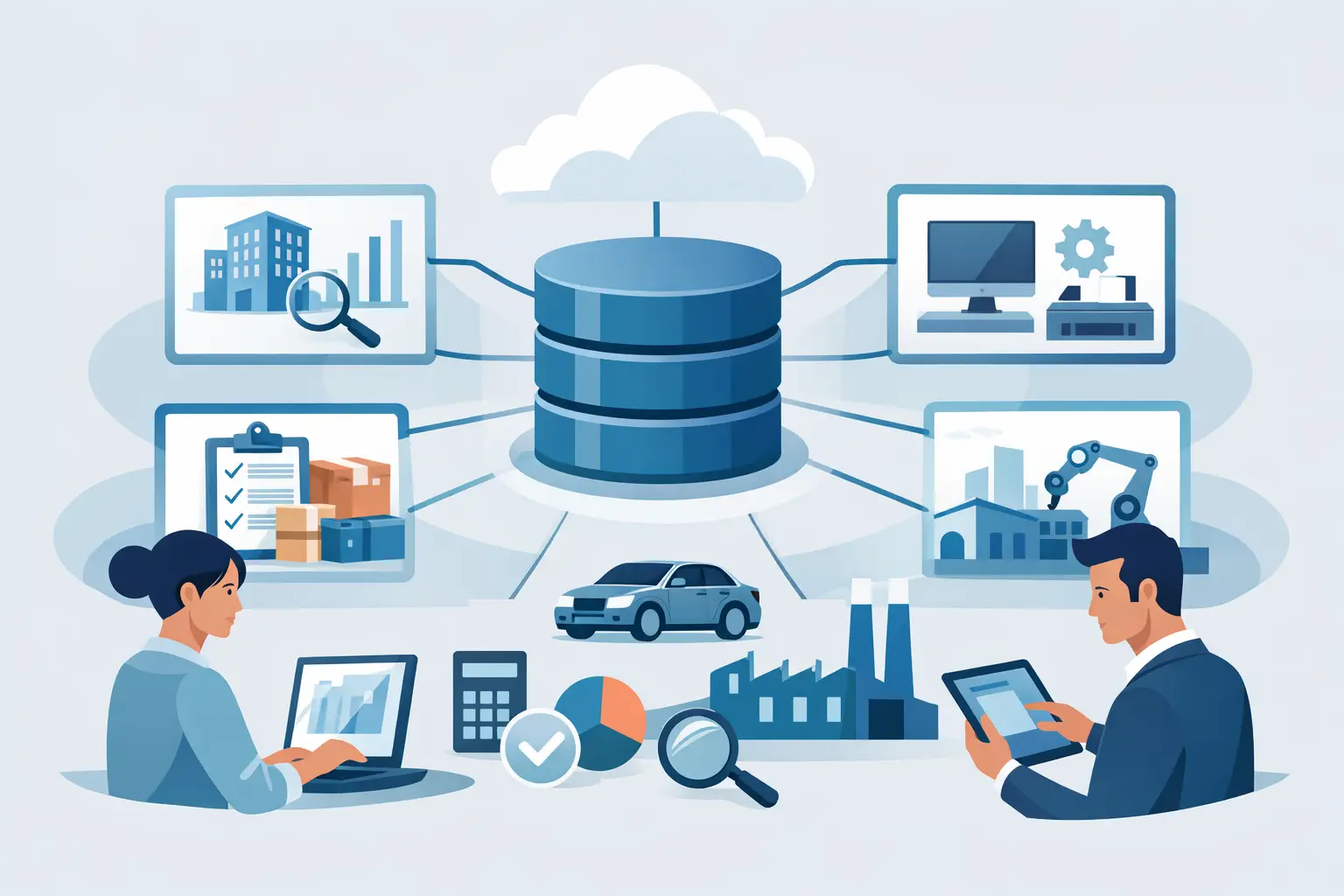
A single data repository eliminates the typical problem of multiple versions of the truth. Administration can check equipment availability, a location manager sees assigned assets, and finance receives the data needed for reconciliation without manually merging files. Each of these functions looks at the same asset, even though they use the information for different purposes.
However, centralization does not mean that all users should have the same level of permissions. A well-configured system provides data according to roles. A field employee can confirm the presence of a device, the person responsible for administration can approve a transfer, and the finance department can control the record data. Such a division speeds up work while protecting information quality.
Process integration is also important. If the asset system functions completely separately from purchasing, accounting, service, and user management, some data will still be re-entered. Not every organization needs extensive integration with every system right away. However, it is worth determining where source data originates and which information should be transferred automatically to avoid entering the same data multiple times.
For many companies, inventory still means a period of intense work, involving people from various departments and subsequently explaining hundreds of discrepancies. Technology does not relieve you of the obligation to confirm the state of assets, but it changes the way this task is performed.
Mobile code scanning or tag reading allows inventory teams to confirm items without manually transcribing numbers. The system continuously compares readings with the registry, points out items not found, detected in the wrong location, or requiring explanation. Instead of creating a separate set of notes to be transcribed later, the organization works on up-to-date data.
The greatest impact is achieved when inventory management ceases to be a one-off corrective action. Regular checks of selected asset groups, locations, or high-value equipment allow discrepancies to be identified earlier. Spreading the workload over time reduces pressure on teams and limits the scale of adjustments at the end of the accounting period.
Asset administration involves many deadlines: inspections, maintenance, expiring warranties, periodic usage confirmations, planned retirements, or mandatory checks. Managing these in calendars and auxiliary files only works with a small number of items and a stable team.
Automatic notifications assigned to specific categories and asset statuses shift responsibility from an employee's memory to the process itself. The relevant person receives a message in advance, and the administrator can see which tasks have been completed and which require escalation. This is particularly important where a delay in maintenance or inspection could mean downtime, additional costs, or issues with maintaining required documentation.
It is worth avoiding an excess of alerts, however. If the system reminds everyone about everything, users stop responding. Effective implementation defines priorities, recipients, and the consequences of inaction. Automation should direct attention to events requiring decisions, rather than generating another stream of messages.
The first step should be to determine what decisions the organization wants to make based on asset data. Is the priority to limit purchases, speed up inventory, control equipment across multiple locations, or ensure records comply with procedures? The answer determines the scope of data and processes that need to be organized first.
Next, you need to define the standard for asset descriptions and responsibility for their lifecycle. Naming conventions, categories, locations, and statuses should be understandable to operational users while being precise enough for administration and finance. There is no point in creating dozens of fields that no one will update. A smaller set of data with confirmed quality is better than extensive records based on guesswork.
Only on this basis is it worth choosing identification technology, labeling models, and the method of conducting audits. Barcodes may be sufficient for some equipment, while RFID works well where the speed of reading a large number of items is important. The choice depends on the type of assets, working conditions, number of locations, and the expected level of automation.
The EXINO platform, based on the eMajątek 4.0 methodology, combines these elements into a single working model: record-keeping, monitoring, inventory, and resource optimization. However, the key remains implementing processes in a way that fits the organization's realities, rather than just launching another tool.
Evaluating automation solely by the number of registered items does not say much about its value. Management and process owners should primarily observe the time required for inventory, the number of discrepancies, the time taken to process asset transfers, and the share of purchases preceded by verification of available resources.
It is also worth measuring the degree of data completeness, the timeliness of required actions, and the number of items without an assigned user or location. These indicators quickly show whether the system supports daily operational discipline. If data is only up-to-date right after an inventory, the problem lies not in the report, but in the process of recording changes.
The best time to start changes is not the next big inventory or an audit revealing shortages. It is the moment the organization decides that every movement of an asset must leave a reliable trail. That is when administration stops reconstructing the past and begins to consciously manage resources and costs.